Basic — individual domains
Unit square#square
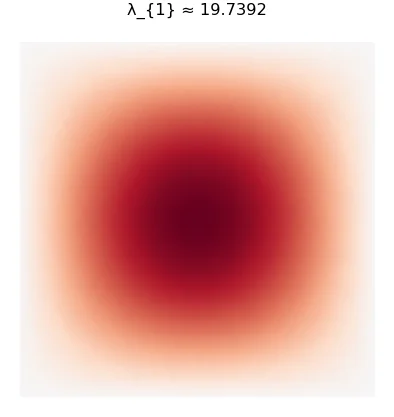
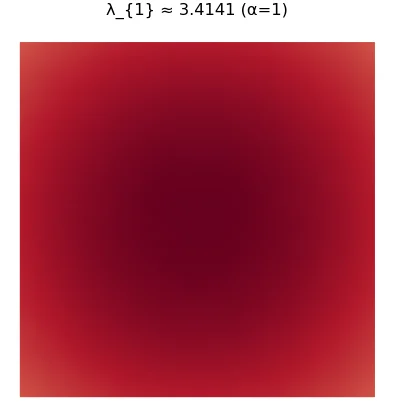
[0,1] × [0,1]. Separable; every eigenvalue is π²(m²+n²) with m,n ≥ 1.
Ref. Courant–Hilbert (1953), §V.5
mesh: 513 vertices, 944 triangles, P2 Lagrange
Dirichlet boundary
Neumann boundary
Robin boundary
Steklov boundary
Unit disk#disk
Radius 1. Eigenvalues are squares of zeros of Bessel J_m.
Ref. Courant–Hilbert (1953), §V.5; Girouard–Polterovich, J. Spectral Theory 7 (2017).
mesh: 1,594 vertices, 3,058 triangles, P2 Lagrange
Dirichlet boundary
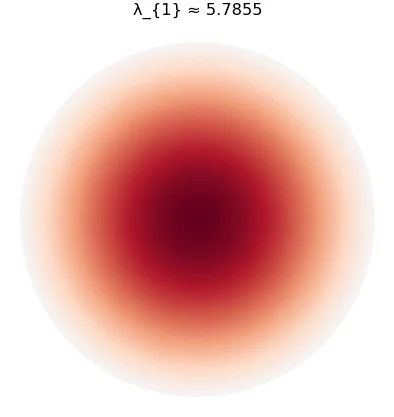
Neumann boundary
Robin boundary
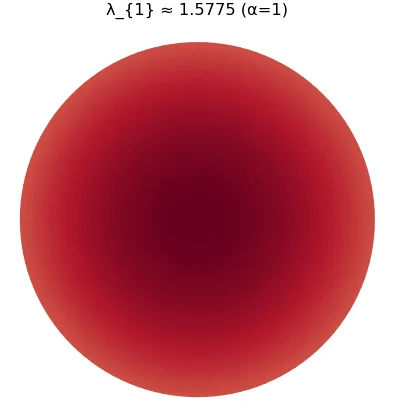
Steklov boundary
Polygonal — individual domains
Equilateral triangle#equilateral-triangle
Side 1. Lamé (1833) derived the closed-form spectrum λ_{m,n} = (16π²/9)(m² + n² + mn).
Ref. Lamé (1833); McCartin, SIAM Rev. 45 (2003).
mesh: 231 vertices, 400 triangles, P2 Lagrange
Dirichlet boundary
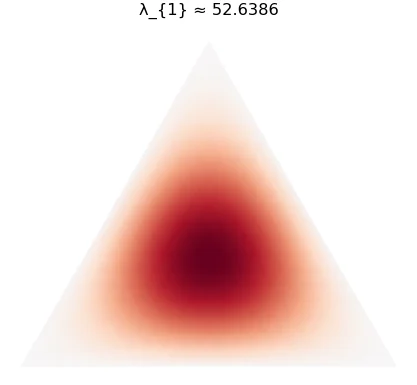
Neumann boundary
Robin boundary
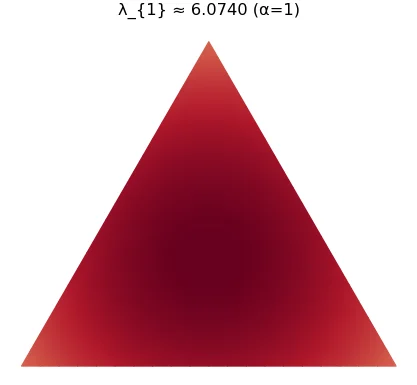
Steklov boundary
Right isoceles triangle#right-isoceles-triangle
Legs of length 1. Half-square: Dirichlet spectrum is π²(m²+n²) with m > n ≥ 1.
mesh: 279 vertices, 487 triangles, P2 Lagrange
Dirichlet boundary
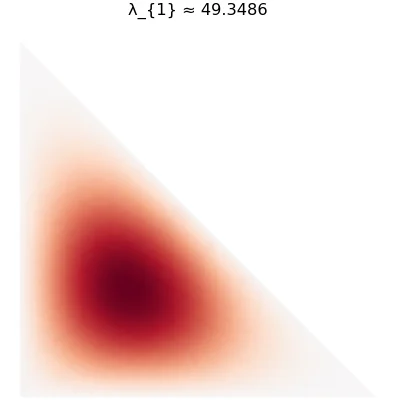
Neumann boundary
Robin boundary
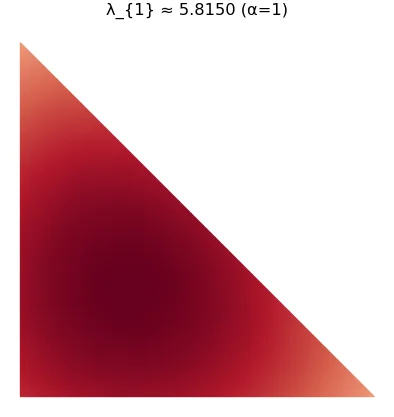
Steklov boundary
30-60-90 triangle#30-60-90-triangle
Short leg 1, long leg √3. A tiling (Lamé) triangle with fully integrable billiard.
Ref. Integrable triangle (30-60-90 is one of the three Lamé triangles).
mesh: 456 vertices, 815 triangles, P2 Lagrange
Dirichlet boundary
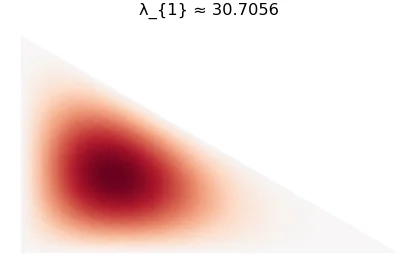
Neumann boundary
Robin boundary
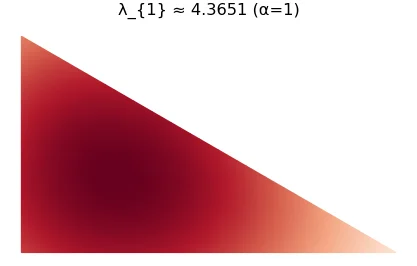
Steklov boundary
Isoceles trapezoid#trapezoid-iso
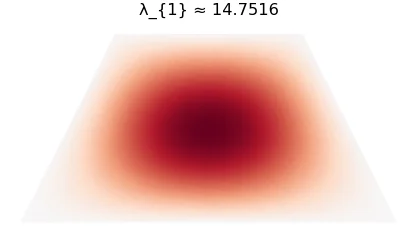
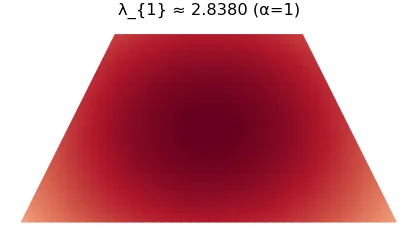
Isoceles trapezoid with parallel bases 2 and 1, height 1.
mesh: 775 vertices, 1,442 triangles, P2 Lagrange
Dirichlet boundary
Neumann boundary
Robin boundary
Steklov boundary
Non-convex — individual domains
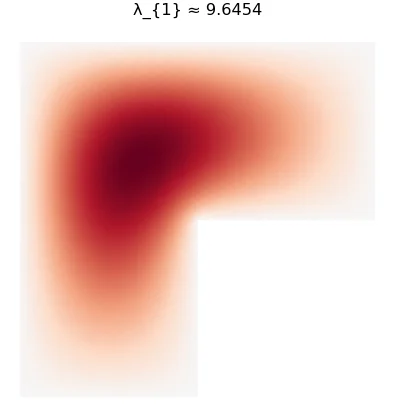
L-shape#l-shape
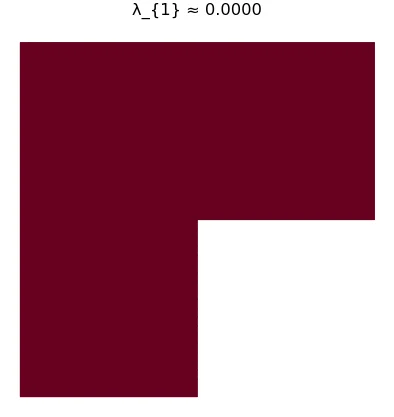
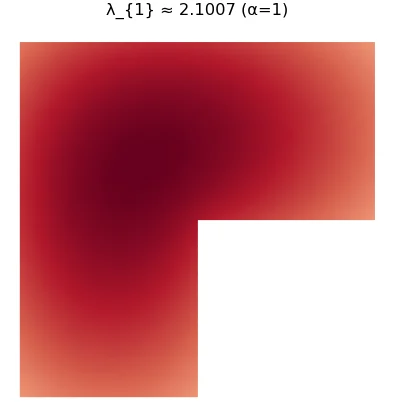
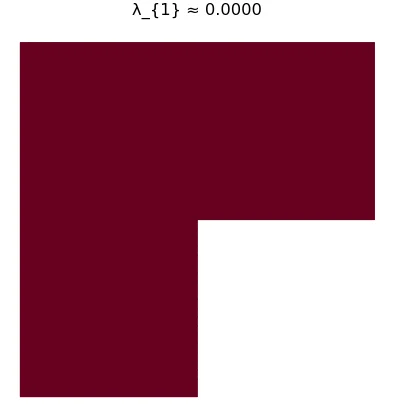
[-1,1]² with the lower-right quadrant removed. The eigenfunctions have an r^{2/3} corner singularity at the re-entrant corner (Fox–Henrici–Moler 1967).
Ref. Fox–Henrici–Moler, SIAM J. Numer. Anal. 4 (1967).
mesh: 1,486 vertices, 2,810 triangles, P2 Lagrange
Dirichlet boundary
Neumann boundary
Robin boundary
Steklov boundary
Non-concentric annulus#annulus-offcenter
Unit disk with an interior disk of radius 0.25 centred at (0.4, 0) removed. Symmetry-broken variant of the annulus.
mesh: 4,062 vertices, 7,868 triangles, P2 Lagrange
Dirichlet boundary
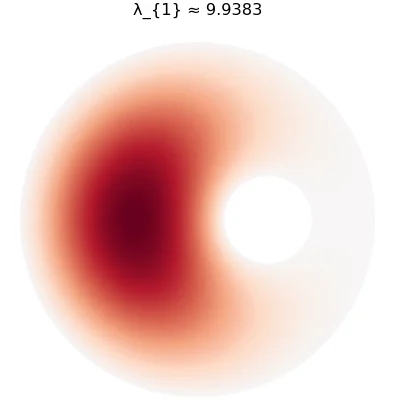
Neumann boundary
Robin boundary
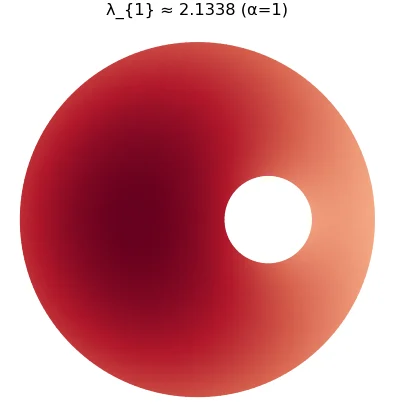
Steklov boundary
Curved boundary — individual domains
Reuleaux triangle#reuleaux-triangle
Intersection of three unit disks centred at the vertices of an equilateral triangle of side 1; a curve of constant width (Reuleaux 1875).
mesh: 4,801 vertices, 9,363 triangles, P2 Lagrange
Dirichlet boundary
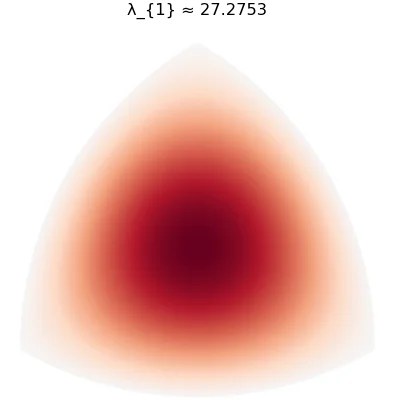
Neumann boundary
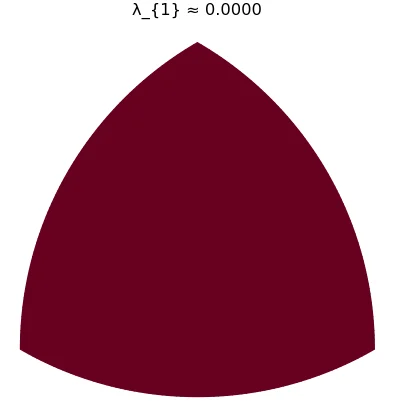
Robin boundary
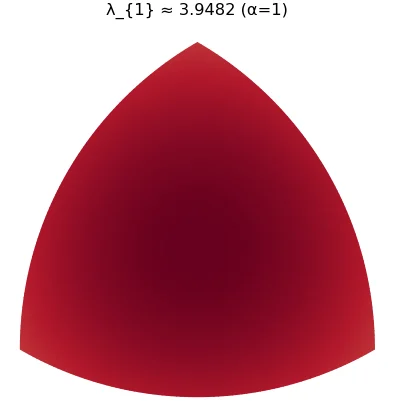
Steklov boundary
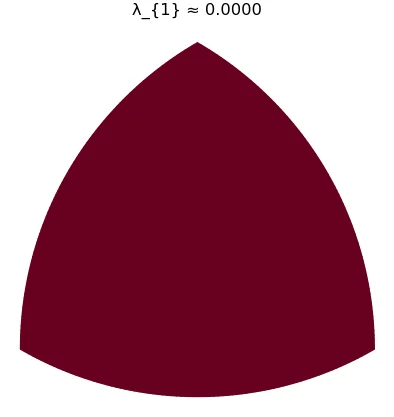
Chaotic billiards — individual domains
Cardioid#cardioid
r = 1 − cos θ. The classical billiard is ergodic, mixing and K (Markarian 1993); extensively studied in quantum chaos (Robnik 1983; Bäcker–Steiner 1998).
Ref. Robnik, J. Phys. A 16 (1983); Bäcker–Steiner (1998).
mesh: 7,387 vertices, 14,532 triangles, P2 Lagrange
Dirichlet boundary
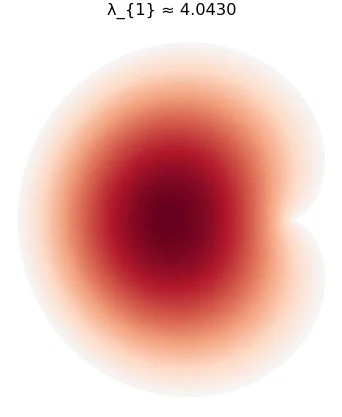
Neumann boundary
Robin boundary
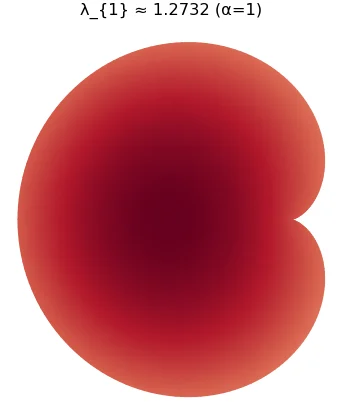
Steklov boundary
Polygonal — parametric families
Regular n-gon#regpoly
Regular n-gon inscribed in the unit circle. As n → ∞, the spectrum converges to that of the unit disk.
Dirichlet boundary
Neumann boundary
Robin boundary
Steklov boundary
Isoceles triangle (apex angle θ)#isotri
Isoceles triangle with base 1 and apex angle θ. At θ = 60° reduces to the equilateral triangle.
Dirichlet boundary
Neumann boundary
Robin boundary
Steklov boundary
Rhombus (acute angle θ)#rhombus
Unit-side rhombus with acute interior angle θ. At θ = 90° reduces to a unit square.
Dirichlet boundary
Neumann boundary
Robin boundary
Steklov boundary
Non-convex — parametric families
Annulus (inner radius r)#annulus
Concentric annulus { r < |x| < 1 }. Eigenvalues are determined by cross-products of Bessel functions J_m, Y_m.
Dirichlet boundary
Neumann boundary
Robin boundary
Steklov boundary
Pac-Man (opening θ removed)#pacman
Unit disk with a sector of opening angle θ removed; the re-entrant angle at the origin is 2π − θ, generating an r^{π/(2π−θ)} corner singularity.
Dirichlet boundary
Neumann boundary
Robin boundary
Steklov boundary
Curved boundary — parametric families
Rectangle (aspect ratio r)#rect
Rectangle [0, r] × [0, 1]. Separable spectrum λ_{m,n} = π²((m/r)² + n²).
Dirichlet boundary
Neumann boundary
Robin boundary
Steklov boundary
Ellipse (aspect ratio e)#ellipse
Ellipse with semi-axes (1, 1/e). Eigenfunctions are products of angular and radial Mathieu functions.
Dirichlet boundary
Neumann boundary
Robin boundary
Steklov boundary
Sectors — parametric families
Circular sector (opening α)#sector
Unit disk sector of opening α. The eigenfunctions are J_{kπ/α}(√λ r) sin(kπθ/α).
Dirichlet boundary
Neumann boundary
Robin boundary
Steklov boundary
Chaotic billiards — parametric families
Robnik billiard (ε)#robnik
Image of the unit disk under the conformal map z = w + εw². Interpolates between the integrable disk (ε = 0) and increasingly chaotic billiards; ε = 1/2 yields the cardioid.
Ref. Robnik, J. Phys. A 16 (1983).
Dirichlet boundary
Neumann boundary
Robin boundary
Steklov boundary
Sinai billiard (hole radius r)#sinai-family
Square [-1,1]² with a central disk of radius r removed. The classical billiard is a K-system (Sinai 1970) for 0 < r < 1.
Ref. Sinai, Russ. Math. Surveys 25 (1970).
Dirichlet boundary
Neumann boundary
Robin boundary
Steklov boundary
Stadium (half-length a)#stadium-family
Rectangle [-a, a] × [-1, 1] with unit semicircular caps. The classical billiard is ergodic and K-mixing for every a > 0 (Bunimovich 1974); a = 0 is the unit disk.
Ref. Bunimovich, Commun. Math. Phys. 65 (1979).
Dirichlet boundary
Neumann boundary
Robin boundary
Steklov boundary
Collapsing / thin — parametric families
Isoceles triangle (height h)#thintri
Isoceles triangle with base 1 and height h. The limit h → 0 realises the thin-domain asymptotics λ ~ (const)/h² (Friedlander–Solomyak 2009).
Ref. Friedlander–Solomyak, ESAIM COCV (2009).
Dirichlet boundary
Neumann boundary
Robin boundary
Steklov boundary
Dumbbell (neck half-width n)#dumbbell
Two unit disks centred at (±1.3, 0) connected by a rectangular channel of half-width n. As n → 0 the first two Dirichlet eigenvalues become asymptotically degenerate (Jimbo 1989; Arrieta 1995).
Ref. Jimbo, J. Diff. Eq. 77 (1989); Arrieta, J. Diff. Eq. 118 (1995).
Dirichlet boundary
Neumann boundary
Robin boundary
Steklov boundary
3D domains — parametric families
Ball B³ (radius R)#ball
Open 3-ball of radius R with the Dirichlet Laplacian. Eigenvalues are squared zeros of spherical Bessel j_l; shown as a rotating GIF with a transparent hemisphere and a coloured cut-plane.
Dirichlet boundary
Neumann boundary
Robin boundary
Steklov boundary
Box [0,a]×[0,1]×[0,1]#box
Axis-aligned rectangular box with Dirichlet boundary. Separable spectrum. Rotating GIF shows three mid-plane slices coloured by the eigenfunction.
Dirichlet boundary
Neumann boundary
Robin boundary
Steklov boundary
Closed 2-manifolds — parametric families
Sphere S² (radius R)#sphere
Round 2-sphere of radius R with its Laplace–Beltrami operator. Spectrum λ_l = l(l+1)/R² with multiplicity 2l+1.
Dirichlet boundary
Neumann boundary
Robin boundary
Steklov boundary
Flat torus T² (aspect ratio e=a/b)#torus
Flat torus ℝ²/(Z × bZ). Spectrum 4π²(m² + (n/b)²); eigenfunctions are products of sines and cosines.